

Contents
1. Preface
2. Carbon Neutrality Targets for New Energy Vehicle Technology Development
3. Conclusion
1. Preface
Carbon neutrality targets will have a significant impact on global politics, economy and society, and countries are actively responding to them, and international academics are conducting research on them: KR. Richards (2004) analyzed forest carbon sinks for reducing carbon emissions in detail through more than 10 years of research [1]; HepburnC (2007) systematically reviewed and summarized the carbon emissions trading mechanism of the Kyoto Protocol [2]. D Tilman R (2009) analyzed the triple dilemma of global food, energy and environment, and considered carbon neutral as the most effective solution [3]; Lovell Heather C (2010) studied the inner mechanism of carbon offset mechanism in depth [4]; Sovacool Benjamin (2011) critically proposed the problems of global carbon trading market from four aspects [5]. In recent years, domestic scholars have also started to conduct in-depth research on this topic: Deng Mingjun (2013) applied the information visualization software CiteSpace II to generate a knowledge map of carbon neutral theoretical research, and deeply analyzed the knowledge base and frontier evolutionary trajectory of international carbon neutral theoretical research [6]; Wang Can (2020) believed that governments, enterprises, and individuals have crucial and focused roles in the process of moving toward a carbon neutral vision. A scientific policy system is needed to form a systematic and effective incentive mechanism to promote the rapid convergence of capital and talent toward carbon neutral technology innovation and market-oriented application [7].
Zou Cai (2021) believes that the "new energy" + "smart energy" system, which is clean, carbon-free, intelligent and efficient, is the development trend and direction of the world energy transition [8]; Yang Xiejun (2021) believes that in order to achieve the goal of carbon neutrality by 2060, it is necessary to establish some basic principles. In order to achieve the goal of carbon neutrality by 2060, Yang Xiejun (2021) argues that there is a need to establish some basic technological paths to promote low-carbon technology innovation and application, a market-oriented path to establish and improve the carbon market, and an administrative path to strengthen government guidance and regulation [9]; Wang Zhen (2021) focuses on the strategic choices of oil and gas enterprises under the vision of carbon neutrality from five aspects based on the analysis of their strategic transformation background [10]. Carbon neutrality means that enterprises, groups or individuals measure the total amount of greenhouse gas emissions produced directly or indirectly in a certain period of time, and offset the carbon dioxide emissions produced by themselves in the form of afforestation, energy conservation and emission reduction to achieve zero carbon dioxide emissions, and carbon neutrality is the main means for human beings to achieve the reduction of carbon dioxide emissions. As a pioneer in energy conservation and environmental protection, new energy vehicles also play an important role in reducing CO2 emissions, and their related technologies are beginning to develop in a more low-carbon and environmentally friendly direction in order to achieve the goal of carbon neutrality as early as possible.
2. Carbon Neutral Targets Promote New Energy Vehicle Technology Development
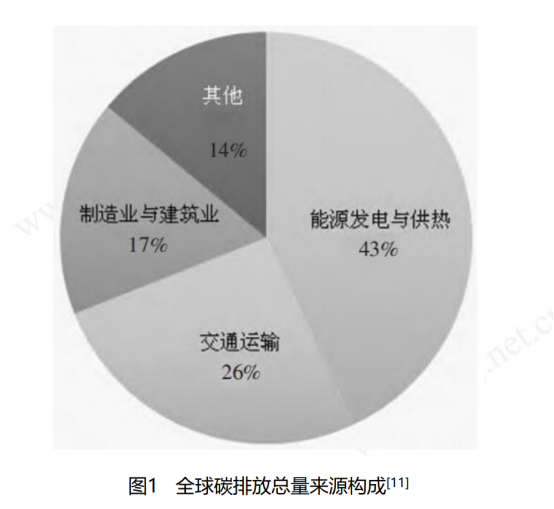
Carbon emissions from transportation account for 26% of total global carbon emissions (Figure 1), and is the 2nd largest source of carbon emissions, including marine, land and air transportation[11] . The energy consumption of the transportation industry is large, and according to relevant data, about 60% of the world's oil consumption in 2020 in the field of transportation, of which the number of cars, as the main land transport, accounts for the largest proportion of land transportation and even transportation as a whole, and the current global car ownership exceeds 1 billion, of which more than 95% of cars are fuel cars, using gasoline and diesel as fuel, and the amount of oil consumed This accounts for about 1/3 of the total global oil consumption[12] . Carbon dioxide is the main component of fuel vehicle exhaust, and a large amount of carbon dioxide is emitted with vehicle exhaust every year worldwide, which has become one of the main sources of carbon emissions. As an important commodity for improving the quality of life, the willingness to purchase related products continues to rise, and car sales continue to grow, among which China has been the world's largest car sales market for many years, and the share of car sales in global car sales in 2020 and 2021 is more than 30%[13-14] . With the increasing car ownership, fuel vehicle exhaust emissions are expected to continue to increase, and the air pollution problem is becoming increasingly serious. At this time, there is an urgent need for new energy sources to replace gas and diesel, to achieve zero emissions of automobile exhaust, and to truly achieve zero pollution to the air environment, so new energy vehicles were born.
New energy vehicles are not only the future of the automobile industry, but also an important way to achieve carbon neutrality. At present, most new energy vehicles use electricity as the power source, and a few use clean energy such as hydrogen fuel and solar energy [15]. The proportion of new energy vehicle sales to total vehicle sales is increasing year by year, and in the foreseeable future, it will completely replace fuel vehicles and completely achieve carbon neutrality in the automotive industry[16] . In recent years, new energy vehicle technology has started to develop in a more low-carbon and energy-efficient direction, both in terms of the core three electric (power battery, electric control system, and drive motor) technology and related auxiliary technology innovation to achieve the main goal of reducing carbon dioxide emissions.
2.1 Power battery
2.1.1 Energy density
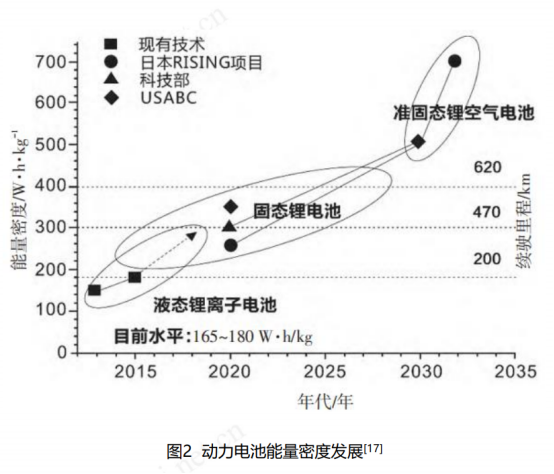
Battery technology is the core technology of new energy vehicles, and its development trend often determines the overall development direction of the industry. Ningde Time, LG, Panasonic, BYD, AVIC Lithium and other power battery companies are actively developing high energy density batteries and solid state batteries. The U.S. luxury electric car Lucid Air, which was delivered in October 2021, has an EPA (U.S. Environmental ProtectionAgency) range of 832 km, making it the world's first mass-produced electric car with a range of more than 800 km. In November 2021, the Ministry of Industry and Information Technology of China announced the Recommended Model List for the Promotion of New Energy Vehicles (batch 10, 2021), the AION LX Plus pure electric SUV from Guangzhou has an energy density of 205 W-h/kg and a NEDC range of 1,008 km, and will be officially launched in January 2022, becoming the world's first pure electric vehicle with an energy density of over 200 W-h/kg and a range of over 1,000 km. In addition, Utilai, BYD, SAIC and other vehicle manufacturers are planning to launch new energy models with semi-solid-state batteries in the future. The development trend of power battery energy density is shown in Figure 2.
2.1.2 Safety
Although the spontaneous combustion rate of new energy vehicles is lower than that of fuel vehicles, once the power battery catches fire, it is very easy to produce an explosion, causing much higher personal and property losses than fuel vehicles.
March 2020 BYD took the lead in releasing the main new energy vehicle safety blade battery, which can easily complete the pinprick test, first equipped with its Han model, BYD Han sales have been climbing since its launch, and so far there has not been a battery fire accident.
In March 2021, BAE released the magazine battery system safety technology, and successfully passed the pinprick heat dispersion test to realize the battery pack pinprick without fire, and no major safety accident has occurred in its models so far.
In September 2021, Great Wall Motor released Dayu battery, which can achieve full coverage of the battery cell chemistry system and ensure that the battery pack does not catch fire or explode in the event of thermal runaway triggered by a single or multiple cells at any location, and is the first to be installed in its salon car products. Future power battery safety will be significantly improved to enhance a safer driving environment for users.
2.1.3 Charging and switching technology
In addition to power battery technology, as an important safeguard technology for new energy vehicles, charging and swapping technology has been continuously developed and has been greatly improved, including Porsche's super charging technology with a maximum power of 350 kW launched in September 2018, which can achieve ordinary household pure electric cars charging to 80% power within 15 min, and the super charging piles of Tesla, Azera and Xiaopeng can reach charging power of 180-250 kW and achieve charging to 80% power within 30 min [18], but even the fastest Porsche Superchargers are still not as fast as fuel car refueling, and the actual charging time may be longer due to the significant slowdown in the final stage caused by trickle charging, and the gap between the charging efficiency of pure electric vehicles and fuel car refueling is still obvious. In recent years, battery swapping technology has emerged as a new way of replenishing energy in new energy vehicles. The battery swapping stations of Azera and BAIC New Energy can replace the batteries of pure electric vehicles within 5 min, which is almost equal to the refueling time of fuel cars and is the most effective way to solve mileage anxiety[19] .
2.2 Electrical control system
2.2.1 Silicon carbide (SiC) power module
Electronic control system is the control center of new energy vehicles, its importance is self-evident, electronic control technology in the early development of new energy vehicle industry is slow, in recent years, rapid development, especially the application of new materials in this field is particularly prominent, the past new energy vehicles generally use IGBT power module, in recent years the emerging silicon carbide began to be used in pure electric models, Tesla, Infineon, BYD, Mitsubishi, Hitachi Tesla, Infineon, BYD, Mitsubishi, Hitachi, CTS Times and other major global IGBT manufacturers are actively developing silicon carbide power modules for new energy vehicles. 2018 Tesla Model 3 pure electric sedan began to change silicon carbide power modules one after another, becoming the world's first new energy model equipped with silicon carbide power modules, in addition, BYD, Azera and other vehicle manufacturers have begun to use silicon carbide power modules, significantly improving the overall efficiency and service life of the electronic control system In addition, BYD, Azera and other vehicle manufacturers have started to use silicon carbide power modules, which significantly improve the overall efficiency and service life of the electronic control system and further reduce energy consumption.
2.2.2 DMI super hybrid technology
Hybrid cars as pure electric vehicles to replace fuel cars in the transition model, the same in recent years, a major breakthrough in electronic control technology, although the hybrid car can effectively solve the long-distance travel mileage anxiety, but the feeder situation even higher than the fuel car class energy consumption has become a major criticism, coupled with the generally higher than the price of the same class of fuel cars, making it an awkward situation, sales have long been stagnant.
In January 2021, BYD released DMI (Dual Mode Intelligent) super hybrid technology, which unprecedentedly eliminates the transmission in the fuel powertrain and replaces it with a single-speed planetary gear, using a self-developed Snapdragon engine with a thermal efficiency of 43%. The DMI system mainly relies on high-powered high-efficiency motors for driving, and the main task of the engine is to generate electricity in the high-efficiency speed range and directly drive the vehicle at the right time, making it easy to achieve ultra-low fuel consumption in the case of power feed, and the fuel consumption of BYD DMI models in the state of power feed for 100 km is generally as low as about 4 L, completely overturning the previous high fuel consumption, this remarkable effect not only relies on high-efficiency engines, but also the electronic control system plays an important role in it. The electric control system also plays an important role. Once this revolutionary technology was released, it immediately sent shockwaves through the industry, and the DMI model became a hot seller in the market as orders were backlogged and demand outstripped supply, boosting the overall sales of hybrid vehicles. In addition, the hybrid vehicle market started to boom again due to the revolutionary technology breakthrough.
2.3 Drive motor
2.3.1 Motor performance
The drive motor directly drives the vehicle and is the core component of the new energy vehicle. The drive motor can release the maximum torque at the starting stage, which makes the acceleration performance of the new energy vehicle far better than that of the fuel car of the same grade, but the torque of the drive motor decays rapidly in the back-end high-speed stage, and the single gear ratio also makes its top speed generally inferior to that of the fuel car of the same grade. In recent years, drive motor technology in power, layout, system innovation: early single drive motor output power is generally less than 80 kW, with the production process and technology level of maturity, the drive motor output power gradually increased, to 2018, generally in the 120kW or so, the Porsche Taycan pure electric coupe in 2019 listed rear motor power up to 350 kW, refreshing the highest power record of the drive motor. Due to the small size of the drive motor, no transmission, you can arrange multiple drive motors in the body, most of the new energy models currently on sale generally use single/dual motor configuration differentiated sales, to enrich the product line at different price levels, some models even arranged three drive motors to further enhance performance; permanent magnet synchronous motor and AC asynchronous motor have their own advantages and disadvantages, in recent years, the vehicle manufacturers began to use these two drive Tesla, Azera and other companies have launched models with a mix of permanent magnet synchronous motors and AC asynchronous motors, with significantly higher overall performance than previous models.
2.3.2 Flat wire motor
The stator winding includes the iron core, copper wire winding, and insulation material. The difference between a flat wire motor and a round wire motor is the way the copper wire is formed, the flat wire facilitates the increase of the slot fill rate of the motor, generally the slot fill rate of a round wire motor is about 40%, while the slot fill rate of a flat wire motor can reach more than 60%. Compared with round wire motors, flat wire motors have better thermal conductivity and lower temperature rise, with some data showing that the temperature rise of flat wire motors is about 10% lower than that of round wire motors. Overall, compared to round wire motors, flat wire motors are more efficient, smaller, lighter and lower cost, which is the inevitable development trend of future drive motors. In recent years, automotive companies have started to gradually use flat-wire motors to replace round-wire motors, as early as 2007 Chevrolet Volt began to use Hair-Pin (hairpin flat-wire motor), in 2013 Nissan used flat-wire motors in its electric vehicle products, in 2015 Toyota's fourth generation Prius began to install flat-wire motors, with the rising sales of Prius, flat-wire motors began to be used on a large scale, followed by SAIC, Great Wall, Porsche, Dongfeng, Dongfeng and other electric vehicles. In the future, flat-wire motors will further replace round-wire motors and become the mainstream of new energy vehicle drive motors.
2.3.3 Integrated motor assembly
The traditional drive motor is independent of the power battery and electronic control system, the power battery will transmit electrical energy to the motor to drive the vehicle, and controlled by the electronic control system, each part of the division of labor to ensure the overall stable operation of the vehicle, but the disadvantages of the separate independent structure is also very obvious, especially the separation of the drive motor and electronic control system will occupy more space in the vehicle, the power battery can only reduce the relative arrangement, while increasing the Mass, can not further increase the battery capacity combined with greater vehicle quality will weaken its acceleration and range, this disadvantage has become more and more obvious in recent years. In response to this problem, companies have begun to develop multi-integrated motor assemblies that integrate drive motors and electronic control systems to save space and reduce vehicle mass, and most importantly, to make integrated motor assemblies further improve transmission and control efficiency and enhance overall vehicle performance.In recent years, companies such as Jingjin Electric (JJE), Founder Motor (FDM) and Huawei have already launched related products, and BYD has launched the world's first eight-in-one motor assembly on the e3.0 platform, integrating drive motor, gearbox, drive motor controller, high-voltage power distribution unit, high-voltage DC converter (Di⁃rect Current-Direct Current converter), on-board bi-directional charger, and complete vehicle performance. The integrated drive motor, gearbox, drive motor controller, high-voltage distribution unit, high-voltage and low-voltage DC converter (Direct Current-Direct Current converter), on-board bi-directional charger, vehicle control unit, and battery management system will increase the overall efficiency from 86% to 89%, reducing the 100 km electric power consumption by 10% compared to the same class of vehicles, achieving faster acceleration and longer driving range. With the gradual maturity of the integrated motor technology, the number of models with this structure will increase.
2.4 Auxiliary technology
In addition to the core technologies, the auxiliary technologies of new energy vehicles have also made rapid progress. Due to the persistent mileage anxiety problem and the gradual withdrawal of new energy vehicle subsidies, improving the range of new energy vehicle enterprises has become an urgent task. The NVH problem, which has never been effectively solved by fuel vehicles, has been solved in the field of new energy vehicles, and the innate quietness and smoothness of drive motors have significantly reduced noise and vibration. The phenomenon of smart network technology, with the inherent structural advantages of new energy vehicles, has become a standard feature of new energy vehicles[21] . The rapid changes in auxiliary technologies have not only enhanced the core strength of new energy vehicle products, but also greatly improved comfort and functionality, further increasing the overall competitiveness of new energy vehicles.
3. Conclusion
The development of new energy vehicle technology determines the overall development direction of its industry. The carbon neutral target has brought the development of new energy vehicle technology to a new stage, showing the following 3 trends.
3.1 The trend of low carbon and energy saving is obvious
The initial development of new energy vehicle technology mainly focused on increasing motor power and driving range, but due to the slow improvement of battery energy density, high manufacturing costs, and the outstanding acceleration ability that cannot be fully played out in urban travel scenarios, the advantages of new energy vehicles in terms of comprehensive performance are not obvious, and the price is significantly higher than the same level of fuel vehicles, making it in an awkward situation, and early sales are slow to increase. In recent years, relevant enterprises have further improved energy density and motor power while developing more advanced electronic control systems and integrated motors to reduce energy consumption and achieve increased range, and the application of environmentally friendly and efficient new materials such as silicon carbide and flat copper wire has significantly reduced carbon emissions during the production of core components for new energy vehicles. Both aspects are developing in the direction of low carbon and energy saving.
3.2 The trend of intelligence is obvious
New energy vehicles are very suitable for intelligence and automation due to their simple structure and more electronic devices. In recent years, intelligent technologies such as artificial intelligence, automatic driving and remote network connection have started to be widely applied in the field of new energy vehicles, and the intelligence level of new energy vehicles is rapidly improving. New energy vehicles are no longer simple transportation vehicles, but mobile spaces that can communicate with drivers and provide them with comfortable and convenient services.
3.3 The trend of industry standardization is obvious
The early development of the new energy vehicle industry was not only at a general level, but also at an uneven level of internal development, with huge gaps, and the enterprises each setting their own technical standards suitable for their own development stages, resulting in different technical parameters, especially in the charging and switching process, and even the inability to charge due to the lack of uniform interfaces. In recent years, the relevant departments began to develop unified standards, and relevant enterprises began to respond positively to produce products with unified interfaces and technical parameters, and have now achieved unified charging standards. With the goal of carbon neutrality becoming an important development direction for global environmental protection, new energy vehicle technology will develop in a more low-carbon and energy-saving direction, and more related new technologies will emerge in the future.
Reference:
[1] RICHARDS K R, STOKES C. A Review of Forest Carbon Sequestration Cost Studies: A Dozen Years of Research[J]. Climatic Change, 2004, 63(1-2):1-48.
[2] HEPBURN C. Carbon trading: A Review of the Kyoto Mech⁃anisms[J]. Annual Review of Environment and Resources,2007(32):375-393.
[3] TILMAN D, SOCOLOW R, FOLEY J, et al. Beneficial biofu⁃els-the food, energy, and environment trilemma[J].Sci⁃ence,2009(325):270-271.
[4] LOVELL H C. Governing the carbon offset market[J].Wiley Interdisciplinary reviews-Climate Change, 2010(3):353-362.
[5] SOVACOOL B K. Four problems with global carbon mar⁃kets: A critical review[J].Energy & Environment,2011 (6):681-694.
[6] Deng MJ, Luo WB, Yin LJ. A review of foreign carbon neutral theory research and practice development[J]. Resource Science, 2013(5):1084-1094.
[7] Wang C., Zhang Y.. Carbon Neutral Vision and Policy System[J]. China Environmental Management, 2020(6):58-64.
[8]Zou Cai, He Dongbo, Jia Chengye, et al. The connotation and path of world energy transition and its significance for carbon neutrality[J]. Journal of Petroleum, 2021(2):233-247.
[9] Yang Xiejun. Diversified paths to achieve carbon neutrality[J]. Journal of Nanjing University of Technology (Social Science Edition), 2021(2):14-25+111.
[10] Wang Zhen, He Xu, Cui Xin. Strategic choices of oil and gas enterprises under the vision of "carbon neutrality"[J]. Oil and Gas Storage and Transportation, 2021(6):601-608.
[11] Li Xiaoyi, Tan Xiaoyu, Wu Rui, et al. Research on carbon peaking and carbon neutral pathways in transportation[J]. China Engineering Science, 2021(6):15-21.
[12] Liu J., Zhu Y. C., Tian Z. Y.. Research on the decarbonization path of transportation in China under the goal of "carbon neutrality"[J]. China Energy, 2021(5):6-12+37.
[13] Economic operation of automobile industry in 2021 [EB/OL]. (2022- 01- 12). http://www.caam.org.cn/chn/1/cate_2/con_5235337.ht ml.
[14] Economic performance of the automotive industry in 2020 [EB/OL]. (2022- 01- 12). http://www.caam.org.cn/chn/4/cate_39/con_5232916.html.
[15] He Q, Meng Zhaoxin, Shen Yi. Analysis and consideration of China's hydrogen energy policy under the goal of "double carbon"[J]. Thermoelectricity, 2021(11):27-36.
[16] Chang W, Liu B, Zhu Yueyan. Development trend of automobile industry under double carbon target[J]. Automotive Vertical, 2021(8):31-35.
[17] Yuan Bo. Review of the development and trends of new energy vehicles[J]. Modern trade industry, 2018 (35): 12-16. [18] Wang Zhenpo. Research on orderly charging and vehicle network interaction technology of electric vehicles under double carbon target [J]. Electronic Engineering Technology, 2021 (5): 1.
[19] Ye Yingjin, Lin Shiyuan, Han Yaru, et al. Consideration of standardization strategy to help the development of new energy vehicle industry under the goal of "double carbon"[C]. The 18th China Standardization Forum, 2021.