

Contents
1. Introduction
2. Introduction to the drive motor in new energy vehicles
3. Needs of motor function in new energy vehicles
4. Application of electric motors in new energy vehicles
5. Key drive motor systems in new energy vehicles
6. Conclusion
1. Introduction
The emergence of new energy vehicles breaks the rules of traditional car energy supply, replacing the power source engine in traditional cars with an electric motor, and converting the car electric energy generated by the motor into mechanical kinetic energy to make the tires roll according to the law of conservation of energy, so that new energy vehicles can run normally. The motor is a very important part of the new energy vehicle, all the energy needed to run the new energy vehicle is from the motor. There are many different types of motors, and the one we use for new energy vehicles is the drive motor system.
In today's society, the market share of new energy vehicles is increasing year by year, and the power source of new energy vehicles relies on electric motors to provide electric energy for them. New energy vehicles not only meet the requirements of consumers for cars and travel, but also meet the environmental protection theme of today's times. This paper summarizes what kind of function of electric motor is needed for new energy vehicles, discusses how electric motor works in new energy vehicles, and studies the role of key drive motor systems in the use of new energy vehicles so that electric motor can be scientifically used in new energy vehicles to achieve the requirements of energy saving and environmental protection.
2. Introduction to the drive motor in new energy vehicles
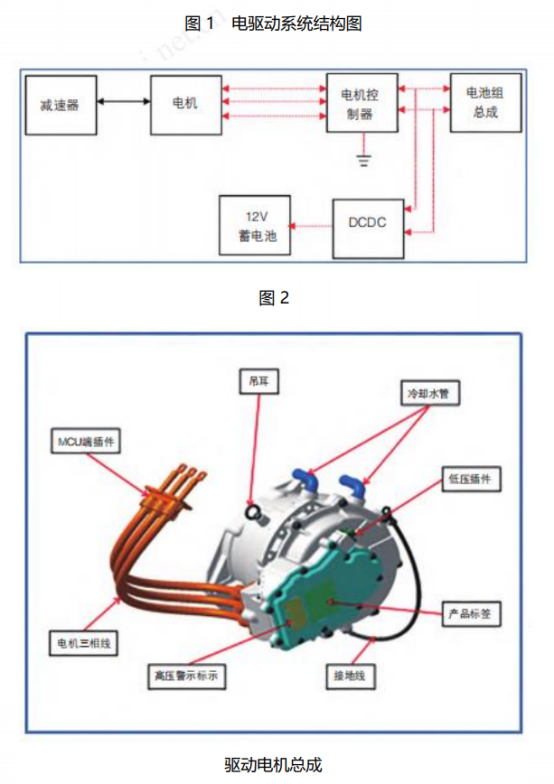
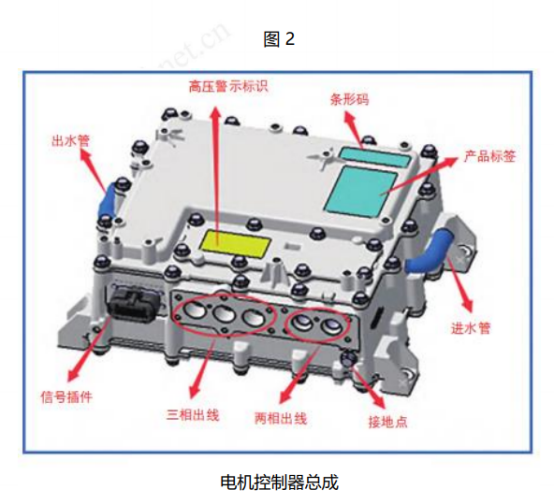
2.1 Drive motor function introduction
The drive motor is a three-phase permanent magnet synchronous motor, which is used as the drive of the pure electric car and is installed in the front compartment. These motors have the characteristics of simple structure, small size, light weight and high efficiency. Under the control of the controller, the motor can work in a wide range of speed to meet the operating conditions of the pure electric car: the motor has a built-in resolver for detecting the rotor speed and position to achieve vector control of the motor; the motor cooling method is liquid-cooled structure.
2.2 Technical parameters of the drive motor (Table 1)
2.3 Motor controller function introduction (DC input, three-phase AC output)

The main functions of the motor controller are:
1 control of the motor operation in electric mode or power generation mode.
2 torque control of the motor drive system.
3 protection functions such as over temperature, over current and over voltage.
4 with CAN communication and diagnosis function.
2.4 Technical parameters of the functional part of the motor controller (Table 2)

3. Needs of motor function in new energy vehicles
The specific motor of the new energy vehicle is normally activated and driven on the premise that the driver should also consider whether the driver is comfortable when driving the new energy vehicle, to help the new energy vehicle better adapt to the driving environment, and to achieve the effect that the new energy vehicle only needs to be charged once in the case of long-term driving. Therefore, new energy vehicles have special requirements in terms of motor-related functions, which are elaborated below.
First, the specific motor of new energy vehicles has a higher level of efficiency standards and power density standards. In the new energy vehicle, the rotation speed range of the motor is relatively large, and the torque range has a high efficiency, so that the power loss will be greatly reduced, and after a one-time charge, the total distance of the new energy vehicle will have a substantial increase in continuous driving.
Second, for new energy vehicles, the motor needs to have a wide range when adjusting speed. In the new energy vehicle, constant torque and constant power are necessary for the specific motor to ensure that the new energy vehicle can ensure a high constant torque even at a slower driving speed, so that the new energy vehicle can be driven uphill under heavy load to ensure that the speed of the new energy vehicle in use can be quickly increased to maintain the enabling efficiency of the new energy vehicle; when the new energy vehicle is driving at a faster speed, the corresponding motor power can be more stable. The corresponding motor power can be sent to the inside from the outside more steadily, and there are more options for speed adaptation. At this time, on a relatively flat road, the new energy vehicle can maintain high speed, and the new energy vehicle can also overtake quickly.
Third, the safety of the motor that ensures the normal operation of the new energy vehicle is higher. In any case, the motor should guarantee the reliability of the new energy vehicle driving, are required to ensure that the new energy vehicle running safety is better, and has the function of resistance to shock and vibration.
Fourth, to maintain the new energy vehicle specific motor related instantaneous power is relatively high, maintain the overload capacity is relatively large. It is necessary to maintain the existence of multiple overload function of the new energy vehicle, which can make the new energy vehicle able to increase the running speed faster and meet the higher slope running requirements.
Fifth, in order to enhance the comfort of using new energy vehicles, the space utilization rate of new energy vehicles needs to be continuously improved, and the weight of new energy vehicles should be reduced in order to make the new energy vehicles rotate more efficiently. As a result, the shell of the motor should be made of lighter metal, the mass of the motor will be smaller and reduce the space occupied by the motor.
Sixth, in line with the premise of new energy vehicles on the motor-related needs, the new energy vehicle motor voltage should be as high as possible, to minimize the cost of converting DC power into fixed-frequency fixed-voltage or frequency-regulated AC power converter, at the same time, to do a good job of safety, set up high voltage protection devices to enhance the safety of motor use.
Seventh, for new energy vehicles, the corresponding motor needs to improve the braking regeneration efficiency, new energy braking conditions to be reflected in the case of low-speed driving, and the power energy collected into the battery, so that new energy vehicles can aptly use the power energy to meet the requirements of environmental protection.
Eighth, the motor of new energy vehicles can better cope with a variety of operating situations. The motor for new energy vehicles needs to have high heat and moisture resistance, so that it can work normally under poor environment when driving and better cope with different operating conditions.
Ninth, the motor for new energy vehicle operation also needs other functions.
1. that the motors can be mass produced.
2. the motor should be operable in terms of operation and repair, one being simple and easy to operate and the other being low cost of maintenance.
3. the motor is kept low in operation and does not produce noise.
4. the structure of the motor is relatively simple and uncomplicated.
4. Application of electric motors in new energy vehicles
4.1 New energy vehicle engine motor application
New energy vehicles have changed the traditional driving method, and its energy uses electricity, replacing the former fuel oil, which can increase the use of renewable energy and achieve the effect of protecting the ecological environment. In order to change the method of driving the car with fuel, the engine of the new energy car should be changed from fuel to electric motor. The motor replaces the internal combustion engine to start the new energy vehicle, and the motor can smoothly use the mechanical energy to start the new energy vehicle. In this way, new energy vehicles work more effectively and meet the purpose of protecting ecology and saving resources.
4.2 Application of electric motor of new energy vehicle parts
With the development of science and technology, the operation method of new energy vehicles has been improved, and the manual operation method has been improved to the automatic operation method. The improvement of this operation method is reflected in the following points: the ability to use the motor to retract and control the rearview mirror of the new energy vehicle; the ability to use the motor to control the windshield wiper and locking system of the new energy vehicle; the ability to use the motor to raise or lower the window of the new energy vehicle.
First, the application of electric motors in the mirror operating system of new energy vehicles can improve the manual control method to an automatic operation method. On the one hand, the driver of a new energy vehicle can focus on driving without manually adjusting the rear view mirror, and on the other hand, he can quickly understand the situation of the car behind him, which increases the safety of driving and avoids traffic accidents.
Second, the motor can be applied to the new energy vehicle wiper and locking system. In the process of driving new energy vehicles, once someone will unintentionally open the door, it will cause great security risks. To address this potential hazard, the locking setup allows the driver to control all the doors in the vehicle to open or close them. The locking system greatly reduces the incidence of traffic accidents caused by accidental door opening, reducing the safety risks of vehicle operation. The motor provides power support for the locking setting, which is an important protection device for the smooth and safe operation of new energy vehicles.
Third, the motor can be applied to the window glass manipulation system of new energy vehicles. The window glass of the car used to be controlled manually, which more or less distracted the car driver and increased the danger of driving. The electric motor and reducer can improve this situation and realize the automatic rising and falling of the window glass of new energy vehicles.
4.3 Application of electric motor in the chassis of new energy vehicles
The motor application of the chassis of new energy vehicles mainly includes the following aspects: first, the motor is applied to power steering; second, the motor is applied to avoid wheel locking. The car relies on electric power for power steering. Traditional cars rely on battery power to complete power steering, the energy supply in this way is relatively unstable and requires constant battery replacement, once the power is exhausted, it will bring unnecessary trouble to the driver. In contrast, new energy vehicles can use electric motors to provide energy for power steering. According to the size of the electric motor power and the corresponding torque state, new energy vehicles can adjust their own steering and choose the rate of steering. Wheel lock is a phenomenon in which the brake clamps the tire, and the tire slides relative to the ground because there is no relative motion of the tire to the brake. Wheel locking will have the following consequences: greatly increase the degree of tire loss; increase the danger factor of the car driving, once the wheel locking, the possibility of sideslip, tailing, sharp turn is greatly increased. Therefore, the prevention of wheel locking is an important issue in the operation of new energy vehicles. New energy vehicles can use electric motors to prevent wheel locking and reduce the danger factor of the car in operation, the specific operation method is to install electric sensors on each wheel to detect the rotation speed of the wheel, always grasp the situation of the tire, once the phenomenon of wheel locking is found, it will quickly feedback to the driver and the relative vehicle parts.
5. Key drive motor systems in new energy vehicles
5.1 Specific applications of permanent magnet synchronous motors in new energy vehicles
Rectangular wave type brushless DC motor and sinusoidal type permanent magnet synchronous motor are the two common motors of permanent magnet synchronous motor in new energy vehicles. The advantage of rectangular wave brushless DC motor is that it is more stable, not disturbed by electromagnetic wave, no commutation spark, and its output is not easy to produce fluctuation, these characteristics determine the rectangular wave brushless DC motor can be used for a long time. Most people choose to use the rectangular wave brushless DC motor in new energy vehicles because of its high efficiency and stability. Rectangular wave brushless DC motor also contains some disadvantages, its production cost is relatively high, because the permanent magnet in the rectangular wave brushless DC motor system is expensive, and the whole system is relatively messy and complicated. How to simplify the operating system of the future rectangular wave brushless DC motor and how to reduce its production cost are the urgent problems that researchers need to study and solve.
5.2 AC induction drive in new energy vehicles
The specific application of the motor AC induction drive motor system corresponding to the motor is generally three-phase asynchronous motor. The advantage of three-phase induction motor is that it is easy to control and the specific internal structure is relatively simple. The operating system of three-phase induction motors is relatively smooth, the use of time can be maintained for a longer period of time, the frequency of repair and maintenance can be relatively low, which reduces the cost of use, the use of three-phase induction motors is relatively good, and other types of motors for comparison, its performance value and price value ratio is more reasonable. The disadvantage of three-phase asynchronous motor is that it requires more power, and the power saved in the new energy vehicle cannot fully maintain the operation of the three-phase asynchronous motor, so it is difficult for the new energy vehicle to completely rely on the three-phase asynchronous motor to complete long-distance driving. Accordingly, the three-phase asynchronous motor requires a large amount of electricity, which also raises its cost of use. Three-phase asynchronous motors should maintain smooth induction motor efficacy when applied to new energy vehicles to prevent shortening the effective use time of three-phase asynchronous motors. Centralized motor drive and conversion of internal combustion engine to electric form are two common ways of AC induction drive motors in new energy vehicles. The cost and price of the centralized motor can be grasped, but the disadvantage is that it is not easy to be produced in large quantities.
6. Conclusion
In summary, the new energy vehicle motor function has a multi-faceted, all-round needs, by exploring the specific use of new energy vehicle motor, we can draw the following conclusions: motor for new energy vehicle engine, parts, chassis, has a high practical value; commonly used in the new energy vehicle key drive motor system is permanent magnet synchronous drive motor system, AC induction drive motor system, etc. The use of electric motors in new energy vehicles can enhance the safety of new energy vehicle operation, reduce the consumption of non-renewable energy, and meet the requirements of maintaining the ecological environment in line with the environmental protection theme of the current era.